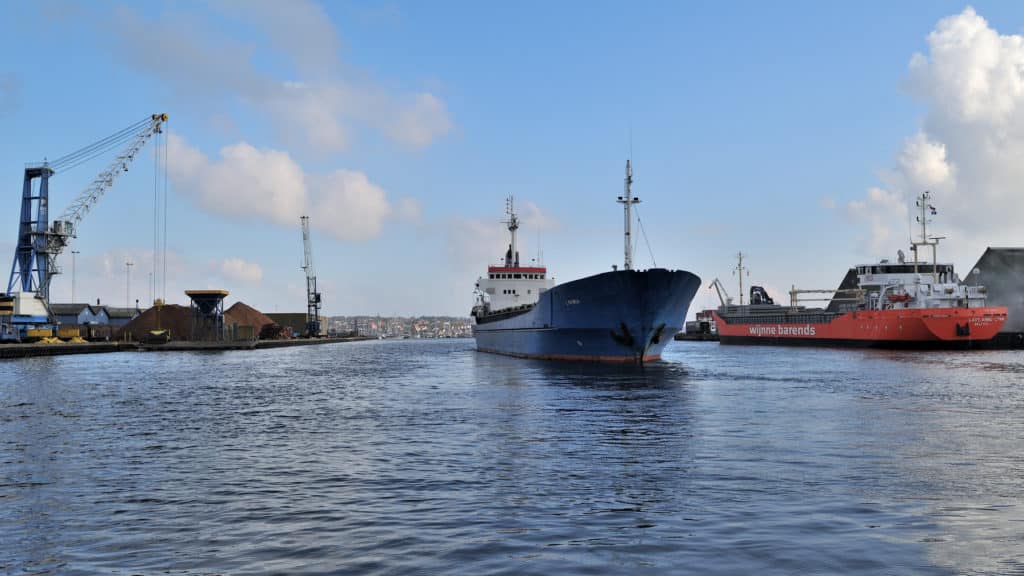
We want to attract companies that will contribute to innovation and development in transport solutions, product refinement and service optimisation. Companies that see an added value in being present in the port.
How is the Port of Kolding developing?
- We work together on business development and services at the port
- We have a physical framework for development – also in the coming years
- We are an active player in development projects on and near the port
- We have a central location for transport solutions and related business
Board of Directors
The Harbour Board manages the port in accordance with the rules of the Harbour Act.
We are a municipal self-government port with a board of directors consisting of 3 politicians and 4 business representatives with different competences. The Board is elected for a 4-year term in the municipal elections.
History
The Port of Kolding is undergoing rapid development – but that’s nothing new. Since its inauguration in 1843, when ambitions were already high, it has grown to become one of Denmark’s 10 largest commercial ports.
2018: the Port of Kolding celebrates its 175th anniversary
2018: New board takes office in connection with new city council; Asger Christensen (V) is chairman
2017: Port of Kolding reaches turnover record – 1,305,916 tonnes of goods over quay
2016: Anders Vangsbjerg Sørensen takes over as port director 1/5 after having been acting port director since 1/1
2009: purchase of 100 tonne giant crane from Port of Hirtshals
2000: Port of Kolding becomes municipal autonomous port
1996: Construction of ro-ro berth and quay extension at Nordhavn
1991: Port of Kolding gets administration building, designed by Lauge Juuls Tegnestue
1982 – 1991: Investments of DKK 20 million. in better services such as cranes, loading facilities, tugboats, etc.
1980: Inauguration of extensive harbour extension on the south side of Kolding Harbour
1967: Scheduled boat to Bornholm established
World War 2: Germans seize Kolding Harbour, which is used extensively
Interwar period: Port of Kolding maintains position as major provincial port – with up to 2000 ship calls annually
World War 1: Port of Kolding is the 4th largest provincial port
1916-1918: River laying, construction of Buen and Sdr. Port road with double railway track and increase of port area from 20 ha to 70 ha.
1909: Major expansion, including deepening of the harbour basin and fairway to 7 metres
1898: Kolding export market is established at the Port of Kolding
1896: The Port of Kolding gets its first crane
1880s: first warehouse for grain and fodder is built
1880s: the island of Trindholm becomes landlocked with the harbour
1875: First railway track to port built
1866: The railway comes to Kolding
1861: Steamship harbour built
1843: Inauguration of the Port of Kolding on 24 October at a cost of 23,547 riksbankdaler and 18 shillings of silver
1842: Establishment of the Port of Kolding begins on 1 May. The dock will be 250 feet (80 meters) long and 180 feet (57 meters) wide with a depth of 9 feet (2.6 meters)
1841: Merchant Caspar F. Müller carries out a census and calculations of a harbour at his own expense. After this, the General Customs Chamber’s harbour inspector, Captain Leth, draws up a plan for the harbour basin
Photo: Kolding City Archives